Your faith matters. So does your mental health.
You shouldn’t have to choose between taking your faith seriously and getting competent, evidence-based care. Faith-informed counseling gives you a place to face what hurts with clinical skill, compassion, and respect for your Christian beliefs.
In person in Chattanooga · Telehealth in Tennessee and Florida
You can hold firmly to your faith while honestly facing what hurts.
Faith doesn’t make you immune to suffering.
Christians experience anxiety, depression, obsessive thoughts, trauma, painful relationships, and seasons of deep uncertainty. Sometimes it’s harder because you believe you shouldn’t be struggling at all, and you wonder whether you’re praying enough or trusting God enough.
You don’t need counseling that reduces every psychological struggle to spiritual failure. And you don’t need therapy that dismisses the faith at the center of your life. Good counseling makes room for both.
Taking your mental health seriously isn’t a rejection of your faith.
Real struggles deserve thoughtful care.
Faith can be woven into work on a wide range of emotional, behavioral, and relational concerns.
01 / Anxiety
Anxiety & OCD
Intrusive thoughts, obsessive doubt, compulsions, and religious OCD, treated as a disorder rather than a failure of faith.
OCD treatment02 / Relationships
Marriage & Relationships
Recurring conflict, emotional distance, betrayal, and rebuilding trust, drawing on shared faith values when it fits.
Couples counseling03 / Healing
Shame, Grief & Trauma
Painful memories, guilt, loss, and shame, without spiritual language that minimizes suffering or rushes forgiveness.
04 / Growth
Identity & Purpose
Life transitions, unwanted behaviors, and the gap between who you want to be and how you’re living.
Men’s counselingClinically grounded. Faithfully informed.
Effective therapy means understanding the specific patterns affecting your life and using the right tools to change them.
Understand Your Story
Your concerns, history, emotional patterns, relationships, and goals, including the role faith plays in how you understand them.
Apply Effective Treatment
Depending on your needs: ERP, I-CBT, ACT, Emotionally Focused Therapy, attachment-based work, and other proven approaches.
Move Toward Change
Practical skills, deeper emotional understanding, healthier responses, and a life that lines up with your values.
When faith gets tangled up with obsessive doubt.
For some Christians, OCD fastens onto questions of salvation, sin, prayer, confession, or whether they truly believe. A sincere spiritual concern becomes a relentless loop of doubt and attempts to feel certain.
Scrupulosity needs OCD-specific treatment. Reassurance, repeated confession, and chasing perfect certainty can actually strengthen it. I use ERP and Inference-Based CBT to address the obsessive process while respecting your beliefs.
 (opens in a new tab)
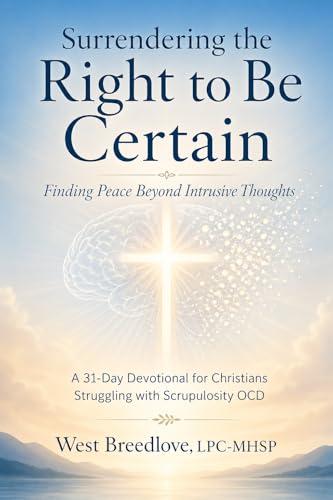
My book · 31-day devotional
Surrendering the Right to Be Certain
A devotional for Christians struggling with scrupulosity OCD.
View on Amazon (opens in a new tab)The goal isn’t to talk you out of your faith. It’s to help you see when OCD is exploiting what matters most to you.
Your beliefs are respected, not imposed.
When you ask for it, Scripture, prayer, theology, and spiritual questions can be part of the conversation as they fit your goals.
Integration doesn’t mean every problem has a spiritual explanation. It doesn’t mean using Bible verses as reassurance, bypassing grief, or substituting prayer for needed clinical care. And you can receive counseling without faith integration at all. Clients of every background are welcome.
You don’t have to choose between being honest about your struggles and being serious about your faith.

West Breedlove, LPC-MHSP
- LPC-MHSP
- NCC
- M.A. Biblical Studies (RTS)
- M.A. Clinical Mental Health (Richmont)
I bring graduate training in both clinical mental health counseling and biblical studies, along with more than two decades of Christian ministry.
My clinical work focuses on OCD, marriage and relationships, men’s issues, trauma, and unwanted behavior patterns. I understand how central faith is for many clients. My role isn’t to push you toward a particular spiritual conclusion. It’s to provide skilled therapy that respects your convictions.
Keep exploring.
Article
Why You Can’t Stop Intrusive Thoughts (And What Actually Helps)
Why fighting your thoughts backfires, and what helps instead.
Read the articleArticle
What Is I-CBT for OCD? Inference-Based CBT Explained
How I-CBT untangles the reasoning behind obsessive doubt.
Read the articleArticle
How Do I Know If I Need Couples Therapy?
Signs it’s time to get help, before things fall apart.
Read the articleQuestions about faith-informed counseling
What is faith-informed counseling?
Professional mental health treatment that thoughtfully incorporates your religious beliefs and values when you want it to, while staying grounded in sound clinical assessment and treatment.
Is this the same as biblical counseling?
No. This is clinical therapy from a licensed counselor, with faith integrated when it helps. It doesn’t replace clinical treatment with Scripture, and it doesn’t override clear biblical teaching either.
Do I have to be a Christian to work with you?
No. I welcome clients from all religious backgrounds and those with none. Faith integration is optional.
Will we pray or study Scripture in sessions?
Only when you request it and it fits your treatment goals. Neither is a required part of counseling.
What if I’m angry at God or struggling with doubt?
That’s more common than people admit, and it’s welcome here. Honest struggle is often where real progress starts. You can also talk about painful experiences with the church without pressure to reach a predetermined conclusion.
Is Christian counseling a substitute for OCD treatment?
No. OCD responds best to specialized approaches like ERP and I-CBT. Faith-informed care respects your convictions while addressing what actually keeps OCD going.
Do you offer online counseling?
Yes. In-person sessions are in Chattanooga, and secure telehealth is available for clients located in Tennessee and Florida.
Do you accept insurance?
Reconciled Hope is a private-pay, out-of-network practice. A superbill is available on request; reimbursement depends on your plan. See rates.
Find hope. Find healing. Move forward.
Whether it’s anxiety, obsessive doubt, a hurting marriage, shame, or a painful season, there’s room here for both your mental health and the faith that matters to you.
Reconciled Hope Counseling, LLC · 243 Signal Mountain Rd, Suite 131 · Chattanooga, TN 37405 (opens in a new tab) · 423-930-9030